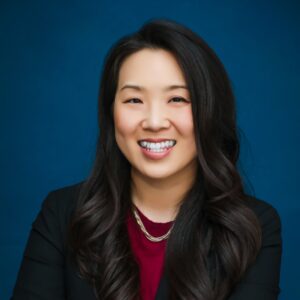
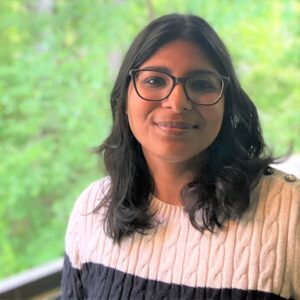
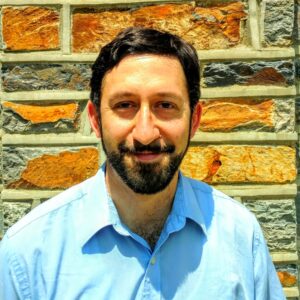
This fall, the Kenan Institute for Ethics is welcoming a new program: the Prison Engagement Initiative. Under the direction of Douglas Campbell and Sarah Jobe, the Prison Engagement Initiative will bring together faculty, staff, students, and community members seeking to engage prisons, the people affected by prisons, and the politics and pathways surrounding mass incarceration.
Campbell, professor at the Duke Divinity School, and Jobe, prison chaplain and prison educator, bring over a decade of experience to this initiative. Since 2009, they have co-directed the Divinity School’s Prison Program, which offers Divinity School students the opportunity to take courses in a local prison along with people who are incarcerated there.
Both Douglas and Jobe hope the PEI will serve as a site for imagining additional possibilities for collaborations that transcend the divide between universities and prisons. “We’re both grateful and excited that Kenan will provide the resources and the space to map the work across Duke that is already being done in relation to prisons, pathways to and from prisons, and the current crisis of mass incarceration,” said Campbell. “We hope that bringing together Duke’s conversations, insights, and resources will generate new insights and constructive forms of engagement—not to mention new energy and hope—for addressing the vast and harmful dynamics of the American prison system.”
“This is the kind of project Kenan likes to support because it bridges classroom and community and draws widely on Duke’s capacity for interdisciplinary research,” said David Toole, interim director of the Kenan Institute for Ethics. “It promises to bring sustained attention to a pressing societal issue in great need of solutions that challenge the status quo, the burdens of which in this case fall disproportionately on underserved communities and people of color.”
Throughout 2022–23, the Prison Engagement Initiative will convene a Strategic Listening Team to map Duke’s existing engagement in prisons, to learn about ongoing research and collaborations, to meet community partners in the Triangle area, and to envision the shape and orientation of an ongoing cross-disciplinary prison initiative at Duke University.
“We believe that by joining the knowledges of business, law, and the humanities together, we can amplify what individual scholars and programs are already doing in and around prisons,” said Jobe. “We are seeking interdisciplinary partnerships that will enable Duke students and professors from all graduate and undergraduate programs to more actively engage prisons, the pathways that lead people to prison, and life after release.”
Those with practical experience and/or academic interest in prisons are invited to email graduate assistant Meredith Manchester at meredith.manchester@duke.edu, introducing yourself and your connection to these issues.
To sign up for the PEI’s list serv, please email program coordinator Jac Arnade-Colwill at jac.arnade-colwill@duke.edu.
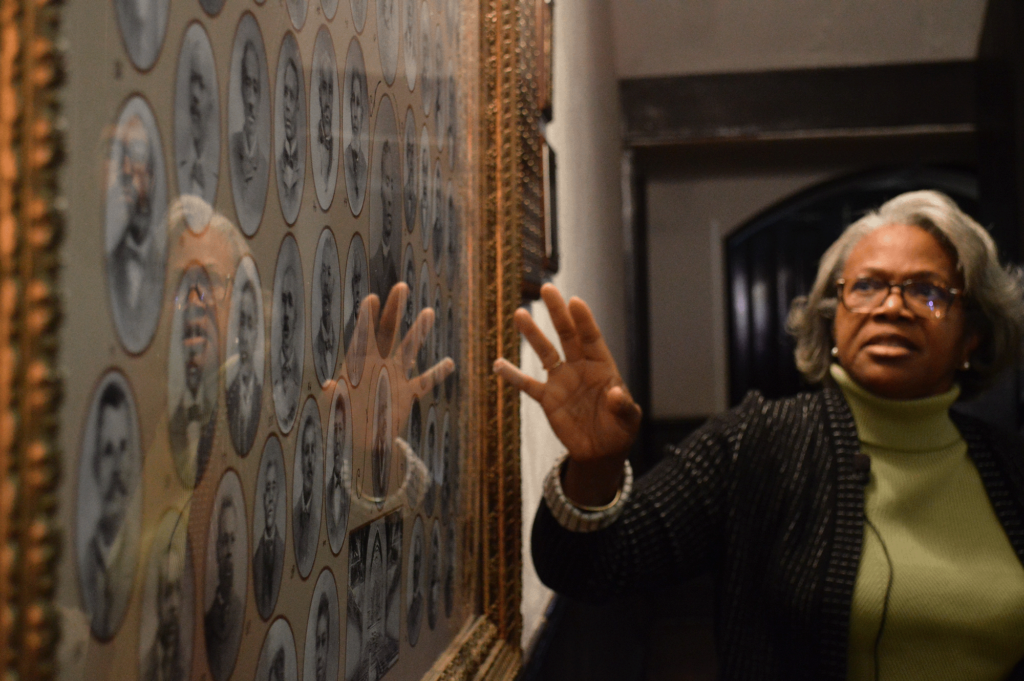
Wilmington historian Cynthia Brown gestures to an artwork at St. Stephen AME Church. (Huiyin Zhou)
Written by Elizabeth Thompson, Trinity Communications, with additional reporting by Sarah Rogers, this article was originally published on Duke University’s Trinity College of Arts & Science website as “Cultural Anthropology Students Learn from a Buried Past.”
Few college students would volunteer to spend a Sunday afternoon in a graveyard, but members of the Fieldwork Methods class in the Department of Cultural Anthropology arranged this trip themselves. They are in Wilmington, North Carolina, visiting the sites of one of the darkest events in the state’s history: the white supremacist coup that destroyed the city’s prosperous Black community in 1898.
“America’s Hallowed Ground challenges us to consider how we respond to locations that have been the scene of violence and sacrifice,” Thompson said. “We are asking students to engage with local communities, really listen and consult with the people who are still living with the legacies of these events, then create artistic responses that honor and elevate this often-overlooked history.”
On November 10, 1898, white mobs ousted democratically elected African Americans from city government and reinstated the white-only rule that had existed before the Civil War. The exact number of Black male citizens of Wilmington who were murdered during the coup is unknown, but estimates range from 60 into the hundreds.
In the days that followed, Black women and children hid in Pine Forest cemetery on the outskirts of the city, hoping to find refuge from persecution.
It’s a hot afternoon in April when the students gather among the gravestones with local historian Cynthia Brown, whose great-grandmother was among those who fled to Pine Forest. Brown, and many other descendants of 1898, are dedicated to uncovering the history of what happened that November and its long-term effects on Wilmington’s Black community.
Pine Forest Cemetery is the next to last stop on a weekend that has jolted the students between the present and the past, the 21st century and the waning days of the 19th. In partnership with guides like Brown, they have visited the site of The Daily Record, the Black-owned newspaper which was burned during the coup; St. Stephen AME Church, a spiritual center and gathering place of the Black community in 1898; and the Cameron Art Museum, home to Duke University art professor Stephen Hayes’ sculpture Boundless, which honors Black U.S. troops who fought at the Battle of Forks Road during the final weeks of the Civil War.
As the students interact with community members, they are practicing ethnographic skills such as interviewing and observation in a real-world setting. They are also forging an emotional connection to the people they encounter and the sites where the events of 1898 unfolded. When they return to campus, they will channel these experiences into projects that combine research and artistic expression.
“Wilmington Landscapes,” by Rebekah Alvarenga
Rebekah Alvarenga, a junior majoring in Cultural Anthropology and Visual & Media Studies, has planned a visual art project. In a series of five collages titled “Wilmington Landscapes,” she layers photos from Wilmington’s past and present with newspaper articles, signs and landmarks to build a nuanced response to the coup and its reverberations down the decades. “I want to connect 1898 to today,” she explains.
When asked about the open space left at the top of many of the collages, Alvarenga replies that she left it there so that the images “had space to grow and change.”
Huiyin Zhou, a sophomore, is combining archival materials and her own photographs taken on the trip into a multimedia project called “Remembering Wilmington 1898.” “My project consists of three found poems and four-photo series,” she said. “To be honest, I didn’t know where to start on my project until I came here.”
Even the brochures at the Hampton Inn where the students spent the night provided material for Zhou to ponder.
“I’m interested in the collective memory surrounding 1898 Wilmington. At the hotel, there’s an advertisement for Poplar Grove Plantation — horse-drawn carriage tours and ghost walks for tourists. But what kind of ghosts are people focusing on? The ghost of white supremacy is still alive.”
While the students reach back through the years to honor the victims of the coup, they also recognize the importance of the bonds they’ve forged with the descendants of 1898 and each other. “I am indebted to all the community members who shared their time, experiences, knowledges and presence with us,” Zhou writes in the introduction to her project. “I am also grateful for all of my fellow students who have collectively formed a community.”
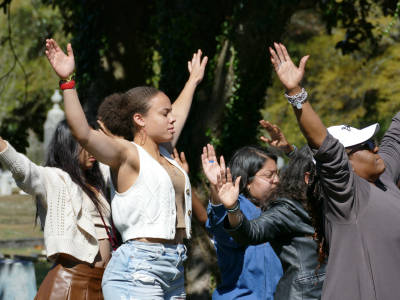
Aya Shabu leads the class in a flocking exercise at Pine Forest Cemetery. (Elizabeth Thompson/Trinity Communications)
Building community is an integral part of the students’ introduction to ethnographic research. Back in Pine Forest cemetery, Durham teaching artist Aya Shabu, who accompanied the class to Wilmington, leads the students, teachers and community guests in a flocking exercise.
They stand close together, each in turn raising an arm, looking at the person beside them, or taking a step forward. The others follow suit, like a flock of birds following the leader. It’s a slow, mesmerizing dance as gesture succeeds gesture.
Shabu encourages the students to move with reverence into the experience of being in this place, to feel it with their whole bodies. Then, she asks them to distill their thoughts about the weekend into one word.
“Mourning.”
“Migration.”
“Legacy.”
“Maybe.”
The flock breaks apart and the students move off into the cemetery, alone or in small groups, to continue exploring.
America’s Hallowed Ground, a project of the Kenan Institute for Ethics at Duke University led by Charlie Thompson and Mike Wiley, will continue in spring 2023 with an exploration of the Trail of Tears and its legacy.
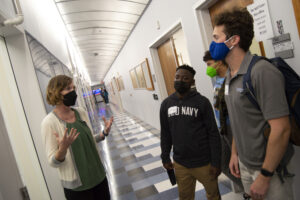
Middle school students from Durham Public Schools visit Duke as part of a GradEngage project run by PhD student Eric Yeats (carrying backpack). Photo by John Zhu.
The Duke Graduate School recently profiled Eric Yeats, a 2021-2022 GradEngage fellow, who partnered with Durham Public Schools to create a robotics club for middle schoolers at two local schools.
When he was an undergraduate at Vanderbilt, Eric Yeats volunteered with an initiative to teach programming to K-12 students. In those sessions, students learned to write code that moved cartoon characters around a computer screen. While some of them had fun, Yeats felt something was missing from the experience—he wanted something more tangible than pixels on a screen.
Now entering his fourth year as a Ph.D. candidate at Duke, Yeats has spent the past few months creating the experience he envisioned by partnering with Durham Public Schools to offer a free robotics club for local middle schools that need more STEM-based afterschool opportunities.
“What really inspired me to do this project is I just really enjoy the process of engineering and problem-solving, and especially programming, and I just wanted to share how much I enjoy it with the kids at school,” said Yeats, a Sloan Scholar who is pursuing a Ph.D. in electrical and computer engineering in Professor Hai “Helen” Li’s lab.
Read the rest of the story on the Duke Graduate School website.
“As an academic field concerned with health and health care issues, particularly the influence of structures, policies, practices, and norms on conditions that unfairly advantage some and disadvantage others throughout society, bioethics has a moral and ethical responsibility to respond to the long-standing intergenerational challenges that racism has posed to the overall health and well-being of Black, Indigenous, Latinx, and other people of color,” the editors write in their introduction.
The report presents articles addressing anti-Black racism in health care settings, health equity research, and the field of bioethics, along with recommendations to address the structural forces perpetuating unequal racial outcomes.
Smith also contributed an article to the report, “Speaking Volumes: The Encyclopedia of Bioethics and Racism,” with co-author Charlene Galarneau. They argue that the encyclopedia obscures racism “by its historical inattention to African American approaches to bioethics, to racism as a bioethics issue, and specifically to racism as a matter of justice.”
Patrick Smith works at the intersection of social ethics, moral philosophy, and theological bioethics. He is Associate Research Professor of Theological Ethics and Bioethics at Duke Divinity School. He also directs the bioethics program at the Trent Center for Bioethics, Humanities, and the History of Medicine.
Read more about Professor Smith in “Good Question,” a Kenan Institute for Ethics publication focused on Duke faculty and the ethical questions driving their research.
What is a college education for? What role does it play in the development of students? And how can faculty help undergraduates navigate their formative years in college?
Katherine Jo believes that college educators need time and space to reflect on these questions—and not just when a student’s personal challenges become apparent in the classroom.
Along with colleague Jesse Summers, she launched a new program, Teaching on Purpose, to help doctoral students approach teaching in ways that support their students’ flourishing as learners and human beings.
Teaching on Purpose Fellow Wan Ning Seah (center) shares her small group’s discussion with the larger group. During this session, fellows used case studies to better understand the challenges faced by students from different backgrounds in order to be more inclusive in their teaching.
Jo is the Director of Program Development and Design for the Purpose Project at Duke—a partnership between the Kenan Institute for Ethics, Duke Divinity School, and the Duke Office of Undergraduate Education, funded by The Duke Endowment. The Purpose Project seeks to integrate questions about meaning, purpose, and character development into university education.
Research demonstrates that traditional undergraduate students (between the ages of 18–22) are in a key developmental phase. As “emerging adults,” students are grappling with who they are, who they want to become, and how to make sense of a complicated world.
Katherine Jo, Director of Program Development and Design for the Purpose Project at Duke.
“It’s bringing a philosophical, holistic approach to teaching,” Jo said of Teaching on Purpose. “We’re thinking of students as whole people, instead of seeing their intellectual activity as separate from their wellbeing and their thinking about the world and their place in it.”
The program also encourages doctoral students to reflect on their own professional identities—not only as scholars, but as educators—and how their discipline connects to questions of meaning and purpose.
Though these questions are not typically associated with STEM disciplines, “it’s not just for the humanities,” Jo said. “Professors can bring these questions into every class. If you’re an engineer, what are you building for?”
This spring’s 17 Teaching on Purpose Fellows come from a variety of Duke University schools, from the School of Medicine to the Nicholas School of the Environment. They represent disciplines as diverse as Literature and Electrical and Computer Engineering.
Jo and Summers, Director of University Initiatives for the Purpose Project, organized the weekly sessions around different themes, readings, and activities, and co-facilitated the discussions. Nearly 40 faculty members from the humanities, engineering, and the natural and social sciences also joined the students over the course of the semester to share their experiences as educators.
Some of the questions posed to fellows were “What is a good teacher of undergraduates?” “How can we invite students into meaningful learning?” and “What are some of the big questions your discipline addresses?”
“For me, one of the most important moments in the workshop was when graduate students from across the disciplines talked about their research to their peers,” said Christine Folch, Assistant Professor of Cultural Anthropology and Environmental Science and Policy. “It ignited interest in each other’s projects, and it showed how each of us approach big questions with different tools.”
“Framing our teaching around the big questions helps students understand why what they’re learning matters—why it matters to them, and if it’s not too grand to say it, why it matters to humanity,” said Summers.
Teaching on Purpose Fellow Laavanya Sankaranarayanan.
“Over the years I’ve recognized that I value a lot of philosophical questions about teaching, and this fellowship gave a space for us to meet and talk about that from a much broader perspective,” said Laavanya Sankaranarayanan, a 2022 Teaching on Purpose Fellow.
Laavanya is a fifth-year Ph.D. candidate in the Genetics and Genomics Program in the Department of Biostatistics & Bioinformatics in the School of Medicine. She studies the roles of non-coding DNA variants and genetic regulatory regions within the context of polycystic ovary syndrome.
Because of her passion for teaching, she pursued pedagogical training through a number of programs offered by the Duke Graduate School (the Certificate in College Teaching Program and the Preparing Future Faculty Program) and finally, Teaching on Purpose (which also counts for credit towards the Certificate in College Teaching.)
It may be difficult to imagine how a student in Biostatistics might find common ground in a discussion about teaching with a student in Political Science, but Laavanya found working with doctoral students in other disciplines to be illuminating.
“I actually liked that it was so varied because it made the conversations so much more interesting,” she said. “At one point, Katherine [Jo] said something like, ‘This is a liberal arts education, because we’re having conversations with students from different [disciplinary] backgrounds,’ and I was like, ‘That’s absolutely true.’ As someone who never went to those types of institutions [that offer a liberal arts education], this is what I had been wanting, and I didn’t know I needed that to help fulfill my interest in lots of varied ideas.”
“There’s tremendous value in having these conversations with people from other disciplines,” agreed Joseph Mulligan, another 2022 Teaching on Purpose Fellow.
Joseph is graduating from his Ph.D. program in the Department of Romance Studies this spring. He studies literature, politics, and intellectual history in 19th and 20th century Spain and Latin America: in particular, the intersections of ethics and literature, civic education, and education reform.
Teaching on Purpose Fellow Joseph Mulligan. “It addresses head-on the fact that students are people—that they’re human beings, and as human beings, they have lots of problems, lots of questions, lots of competing interests,” he said of the program.
While Romance Studies requires its graduate students to take a full semester to study the theory and practice of foreign language teaching, Joseph also took advantage of other pedagogical training opportunities. Through the Duke Graduate Academy, he took a course offered by Duke University Libraries on teaching with archival materials, which he used to create a course model incorporating archival research. He was also a Bass Instructional Fellow.
“Having seen the value in those interdisciplinary conversations, I was really excited to have the most interdisciplinary experience in the pedagogical context,” Joseph said, “which was Teaching on Purpose.”
Through Teaching on Purpose conversations, he realized that he had not always incorporated ethical questions into classroom discussions in ways he would like.
“In talking to colleagues and hearing from faculty across the disciplines, especially from the STEM disciplines, I realized that if I don’t raise those questions, it might be the case that no one ever does in the four years that these students are in school,” Joseph said. “I feel like in the past I’ve focused on comprehension and ‘critical thinking,’ but without really asking the students, ‘How can this help you live your life?…How can this transform the way that you think about yourself, or think about the world, or think about what you want to do?’”
The first run of the program was met with positive feedback from visiting faculty as well as the fellows: responses to a post-program survey unanimously recommended Teaching on Purpose to other graduate students.
“Honestly, it was a great experience,” Laavanya said, “and if you’re interested in big picture questions about education, this is a great space to do that.”
Applications are now open for Fall 2022 Teaching on Purpose Fellows! For more information, click here.
In its first in-person event since the spring of 2020, The Ethics of Now series welcomed “Pachinko” novelist Min Jin Lee to the Durham Arts Council on April 8, 2022.
Adriane Lentz-Smith (right) and Min Jin Lee in conversation at the Durham Arts Council on Friday, April 8, 2022. An audience of 175 attended the talk, which was followed by a book signing.
In an hour-long conversation with host Adriane Lentz-Smith and audience members, Lee discussed a variety of topics—from happiness, morality, and the insights afforded by history to storytelling, racism, and Asian American identity. Below are some excerpts from her comments.
On happiness
One of the reasons I wanted to come here today is you’re the ethics institute, and that is something that I care profoundly about…I don’t believe in [happiness.] I really don’t. I think that the pursuit of happiness is causing people to be miserable. I believe in joy, I believe in gratitude, I believe in meaning, I believe in purpose, I believe in moral goodness. I believe in satisfaction and contentment. But the pursuit of happiness, I think, is a really immature thing.
On her moral sensibility, reading the Bible, and writing
If you are telling stories, and stories are really just our lives made into order, you have to see what you cannot do and what you can do. One of the great lies we tell ourselves in the 21st century is that we don’t judge. What nonsense! We’re judging all the time. You go on Twitter for about three minutes, and you are angry about something. Because we think something was done in a wrong way, which means you’re judging…
We are constantly thinking about morality—what is allowable, what is not allowable, what should be held accountable, what should not be held accountable. And Bible or the Quran or the Torah…they are all discussing what we need in order to live a wise life…
In my reading of the Bible every day, I have learned so much about story and about human characterization, so I wouldn’t stop even if you made me.
On studying history as an undergraduate student
Lee spoke with humor, candor, and empathy about viewing human experience through the eyes of a novelist and researcher.
I wanted to be an English or Literature major, but that seemed so glamorous to me…I thought that I would in major in history, because it’s essentially storytelling, but it’s all nonfiction. It also sounded very solid. Back then, it was very solid, whereas now, it’s, “Oh, you’re a history major, you want to be a waiter.”
Everything that I’ve done in my life…[is] because I have such a strong foundation in history. I tell people all the time, if I didn’t read as much as I did, and I do—I really couldn’t function in the world. And I have nothing but respect for STEM. I went to the Bronx High School of Science, which means that I have an inordinate amount of expertise in math and sciences, and yet I also understand that behind science is this idea of inquiry, and inquiry is a humanities discipline.
So I want to integrate both fact-based learning but also inquiry and philosophy, which is so important, and now that I’ve interviewed so many important people in the world…I have met all these billionaires, and so many of them are philosophy majors. Yeah! So they’re not waiters—and by the way, waiters are not bad!
On framing our lives as stories
I’ll have an incredibly brilliant student come to my office hours, and they’re sobbing. I’m like, “What’s the matter? Talk to me.” And they’ll tell me something that happened that was disappointing. And I say to them, “Do you know that you’re in Chapter Two?” And all of a sudden, it dissipates…and they can feel this relief…Depending on which story you’re telling, it can make you feel like you can control the chaos of life.
On anti-Asian violence
Right now, what’s happening with anti-Asian violence is deeply disturbing, because there’s a lot of documentation of what’s going on and the numbers are appalling, but I’m going to say something weird as a novelist. Beneath that rage that you and I feel…underneath it, I have a question: “Why don’t you like me?” That is my question. Let’s go below that: “I want you to like me. And when you don’t like me, it hurts me.” When you can have those discussions, things can change.
On the desire of Asian Americans to assimilate and to achieve (with the example of being published in The New Yorker)
I think that the wish to be American is something that many Asians and Asian Americans have…Now, obviously that term ‘American’ can mean very many things. If the wish to be American means a wish to be white, then that needs to be questioned.
As for the wish to be published by The New Yorker–I’m going to address it, because I’ve never met a writer who didn’t want to be published in The New Yorker! We think of The New Yorker as probably the most prestigious literary magazine in English, probably in the world. So, if we look at that, and we name that as what it is—the object—then what are we really saying? We’re really saying: we wish to be accepted by the most prestigious literary organization in the world. What we really wish for is recognition. We want universal acclaim.
When I’m with my students, I often say, if you have that wish, that’s not a bad wish. Let’s look at that wish and see what you really, really want, and let’s figure how to get it, and if you think it’s good for you.
Now, the whole thing with things like The New Yorker, or any other imprimaturs which make us feel that we’re accepted–if that requires mortification, and by mortification, I mean killing off parts of yourself in order to be accepted, I always say, hold on. Let’s take a look.
I have always fought very, very hard against trying to kill parts of myself off in order to be accepted, and as a matter of fact, it’s caused me a lot of problems…I have to struggle against a world that wants me to behave in a certain way that can be satisfying, that can get good results.
On “Pachinko” as a universal story
…I’ve leaned so deep into my Korean-ness, I thought for sure that I was going to create an isolated bubble of myself, but ironically, the more particular I got, the more specific I got, the more universal it eventually became. I wrote a book on spec. I didn’t have an agent, I didn’t have a contract, I didn’t get paid to write this book. I spent 30 years of my life researching it on my own coin.
This book is taught in Korea and around the world by people who teach Korean history. If you had asked me, why would anybody want to read a book about the Korean-Japanese people, you would have been a reasonable person to ask the that question…but I said I’m going to just do it because I want to, because I was really upset about the inequities they’d suffered.
On loving your Korean family and Korean identity
I love being with Korean people. I have so much fun. They tease me and I tease them back. There’s a kind of generosity and openness that I really love.
Lentz-Smith and Lee listening to a question from an audience member. Many of the questions were about navigating Asian American identity in the United States amid pressures to assimilate, increased attacks on Asians, and the continued perception of Asians as “perpetual foreigners.”
I’m not saying all Korean people are this way. I get it. One of the reasons why I’m talking about it right this second, is because I hear this, too, when I interview Koreans. They say stuff like this to me: “You’re a nice Korean person…don’t trust those Korean people.”
In my interviews for “American Hagwon,” do you know how many kids I’ve interviewed, who are grown, who’ve said to me, their mothers or fathers have said, “when you go to this excellent school that I’m sending you to, that I sacrificed so much for, don’t hang out with the Koreans”? This is a Korean person telling their Korean kids this.
And I think to myself, I understand why the parent says this…the parents are trying to say, I want you to get the outcome that’s good. Therefore, I want you to have these four years of hell, of hating your peers…or your mirrors. So what you’re really saying is, “I want you to hate yourself. You are your enemy.”
So what I hear these messages…I think, things will change, when we say, we’re here. I like myself, and I like my brothers and sisters. I like my family.


 This fall, the Kenan Institute for Ethics is welcoming a new program: the Prison Engagement Initiative. Under the direction of Douglas Campbell and Sarah Jobe, the Prison Engagement Initiative will bring together faculty, staff, students, and community members seeking to engage prisons, the people affected by prisons, and the politics and pathways surrounding mass incarceration.