Loading

Social Choreography Turns Audience into Artmakers

Parliament
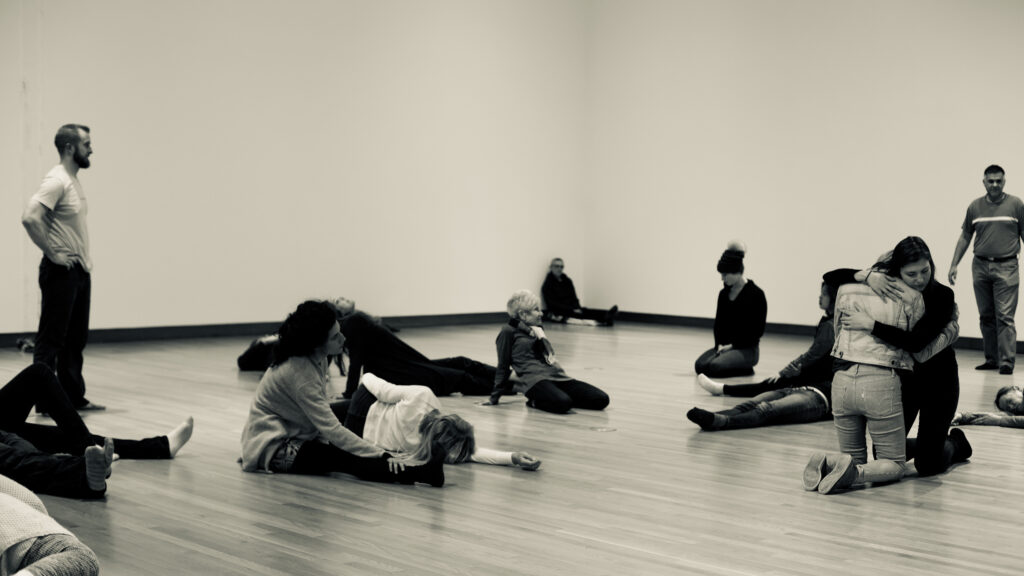
“Parliament” at the Nasher Museum of Art at Duke University in 2018. Photo by Christina Gangos.

When you think about experiencing art, what comes to mind? Likely, you imagine going to a museum to look at paintings, or to the theater to watch a play.

What if instead of observing art, you—and the people around you—were the art?

That’s one of the many ideas behind “Amendment,” a project by Michael Kliën and his Laboratory for Social Choreography, that demonstrates his approach to art making—art as constituted entirely of the interactions of the people in the room.

Four years ago, the Nasher Museum of Art at Duke University hosted Kliën’s “Parliament.” Participants signed up to remain in a gallery space with each other, without speaking and without electronic devices, for up to six or seven hours at a time.

After an initial period of awkwardness and uncertainty, members of “Parliament” found ways to communicate and respond to each other’s movements. Spontaneous interactions emerged. Imaginations activated.

According to Kliën, this kind of experience provokes deep questions about “how we should be in the world”—as individuals, and with each other.
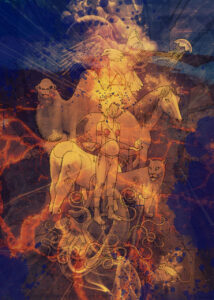
Comic style drawing of a pregnant person surrounded by animals
This concept art for Amendment reflects an origin story drawn from another of Kliën’s projects, the “Social Dreaming Matrix.” Illustration by Rafal Kosakoski.

Unlike “Parliament,” “Amendment” lasts an hour and a half. During the first fifteen minutes, participants will be given instructions that will guide their actions and interactions for the next seventy-five minutes.

Kliën says that part of the instructions, or “propositions,” for “Amendment” is a new origin story for humanity, one reflects new conceptions of “how we relate to the natural world, to others, and to ourselves.” This story was drawn from another of his social choreography projects, the “Social Dreaming Matrix,” which interwove dreams from hundreds of participants during the early days of the COVID-19 pandemic.

After the first fifteen minutes, the participants are free to move, respond to the music playing in the space, interact with each other, negotiate their roles in the piece, and “understand and resist familiar social—and perhaps personal—patterns,” says Kliën. No participants are obligated to do anything they don’t want to do.

There are no recordings and no observers. Everyone is a participant. “There’s nothing but the experience,” said Kliën. “That’s the art.”

Who should sign up for “Amendment”? Anyone 18 years or older, “with a sense of adventure,” said Kliën. Comfortable clothes should be worn, allowing for easy movement and easy sitting on the floor.

Participants can sign up for one or both “Amendment” sessions, which take place from 6 p.m. to 7:30 p.m. on Monday, April 18 and Tuesday, April 19 in the Rubenstein Art Center, or “Ruby,” at Duke University. On Wednesday, April 20, at noon, there will be an open reflection session for people who took part in the sessions in the Ruby Lounge.

Sign up by emailing the Laboratory for Social Choreography at labsc@duke.edu.

Durham Premiere of “Fire of Freedom” Spotlights Historical Black Leader

Mike Wiley in performance as Abraham Galloway. A trunk lies in front of him
Wiley in performance as Abraham Galloway. Photo by Trevon Carr.

CONTACT: Sarah Rogers
(919) 660-3035
sarah.rogers@duke.edu

DURHAM, N.C. — Abraham Galloway was a freedom fighter. Born near Wilmington, N.C. in 1837, he escaped from slavery, became a radical abolitionist, risked his life behind Confederate lines as a Union spy, and recruited hundreds of Black soldiers to fight during the Civil War. He was known for his fiery oratory, his swagger, and his habit of visibly wearing his pistol at his hip. He was part of a delegation of Black southerners who met with Abraham Lincoln in the White House to demand suffrage and the full rights of citizenship. Following the war, he was one of the first Black men elected to the North Carolina state legislature.

Despite these accomplishments, Galloway’s story is not yet well known, even in his home state of North Carolina.

“The Fire of Freedom,” a one-man play starring actor Mike Wiley and featuring vocalist Mary Williams, promotes Galloway’s legacy by depicting the freedom fighter’s journey from ex-slave to the one of the most compelling political leaders of his time.

Wiley will perform “The Fire of Freedom” at the Carolina Theatre at 7 p.m. on Monday, April 11, the play’s Durham premiere. This performance is free and open to the public, but tickets are required. They are available online via registration at TheFireofFreedom.eventbrite.com.

“Galloway’s presence in the story of America should come as no surprise,” said Mike Wiley. “The resilience of enslaved Black people is documented in detail in the pages, songs, and stories of our nation’s history—for those who are looking, for those who are listening. The surprise that a man such as Galloway could exist arises more often from those who are not paying attention.”

An MFA graduate of the University of North Carolina-Chapel Hill and winner of its Distinguished Alumni award, Wiley is an acclaimed actor, playwright, documentarian, and director. He plays dozens of characters in his one-man shows, often based on key events and figures in African American history.

“The Fire of Freedom” is inspired by a biography of Galloway by North Carolina historian David Cecelski. Playwright Howard Craft wrote the theatrical adaptation. Cecelski and Craft will join Wiley onstage after the one-hour play for an audience talkback.

This performance is sponsored by the Kenan Institute for Ethics at Duke University, where Wiley recently began a three-year appointment as Artist in Residence. He will co-direct a project called “America’s Hallowed Ground,” which tells the stories of historical sites through community-engaged art.

Mike Wiley to join Kenan Institute for Ethics as Artist in Residence; Will Co-Direct America’s Hallowed Ground

North Carolina-based playwright and actor Mike Wiley will join the Kenan Institute for Ethics as Artist in Residence for a three-year appointment effective March 1, 2022.

Mike Wiley
Photo credit: Chris Charles.

A graduate of the University of North Carolina’s M.F.A. program in acting and 2017 winner of its Distinguished Alumni Award, Mike Wiley writes, directs, and performs dramas, many of them based on key events and figures in African American history. He embodies dozens of characters in his one-man shows, tours throughout North Carolina and the United States, and leads communities and schools in post-performance discussions about the issues raised in the plays. His catalog as playwright includes a growing number of ensemble cast works as well. He has taught at Duke and UNC as the Lehman Brady Joint Visiting Professor of Documentary Studies and American Studies in 2010 and 2014.

At the Kenan Institute for Ethics, Wiley will co-direct “America’s Hallowed Ground” with Charlie Thompson, Professor of the Practice of Cultural Anthropology and Documentary Studies and Kenan Senior Fellow. Beginning as a Bass Connections project, and conceived in the spirit of Lincoln’s Gettysburg address, this project seeks to honor sites of past struggles, conflicts, and sacrifices that are significant to American history, particularly its history of racial inequality. Many of these sites and their historical connection are not widely known today.

Combining research and engagement with local communities, America’s Hallowed Ground will tell the stories of these sites through the arts, making these histories accessible to a broader public and elevating them to the local, regional, and national recognition they warrant. Wiley and Thompson have already begun working on the first site: Wilmington, N.C., where white supremacists staged a violent coup in 1898 to suppress the growing political power of African Americans.

Wiley is also bringing his practice of engaging communities through the arts to Duke classrooms. With Charlie Thompson, he is currently co-teaching a Cultural Anthropology course that approaches Wilmington 1898 through ethnography and showcases how artistic expression can make research both accessible and memorable to broader populations. Students will travel to Wilmington in April, visiting sites with Thompson and Wiley, doing anthropological fieldwork, and eventually completing public history-oriented projects of their own.

“It’s really Mike’s and my expertise meshing together, in this course,” said Thompson. “We are learning how these different fields can inform one another, and become richer through cross fertilization, and I think the students really get that. They want their work to be relevant, and to reach beyond Duke.”

America’s Hallowed Ground will continue its work in Wilmington this year. The co-directors and their collaborators, many professional artists, will work with community stakeholders to produce art on local sites through podcasts, visual art, choreography, and other modes of digital storytelling. Eventually, they hope to expand the project to other sites, both in North Carolina and nationally.

Wiley’s experience as an artist and educator is integral to the process.

“Ethics happens by participation,” said David Toole, Interim Director of the Kenan Institute for Ethics. “Mike’s a great example of that. His unique abilities as an artist and performer show us the connections between what we do in the classroom and what it means for us to live well in the world.”

“Few creative talents have Mike Wiley’s range of artistic expression,” noted Vice Provost for Interdisciplinary Studies Edward Balleisen, “nor his extraordinary knack for using drama to compel engagement with the lived realities of American history. At once playwright, actor, director, and documentarian, Wiley will challenge Duke students and Durham residents to probe the moral implications of America’s professed ideals, and American society’s imperfect embrace of those aspirations.”

To mark Wiley’s appointment, the Kenan Institute for Ethics is sponsoring a performance of “The Fire of Freedom” this spring. Based on a book by historian David Cecelski and adapted by playwright Howard Craft, this one-man show by Wiley focuses on Wilmington native Abraham Galloway, who escaped from slavery and organized hundreds of Black soldiers to fight against the Confederacy during the Civil War.

The performance will take place at the Carolina Theatre in downtown Durham at 7 p.m. on Monday, April 11. Admission is free, but please register for tickets here. After the play, there will be a talkback with Wiley, Cecelski, and Craft.

New book “Neuroscience and Philosophy” examines human mind through blended disciplines

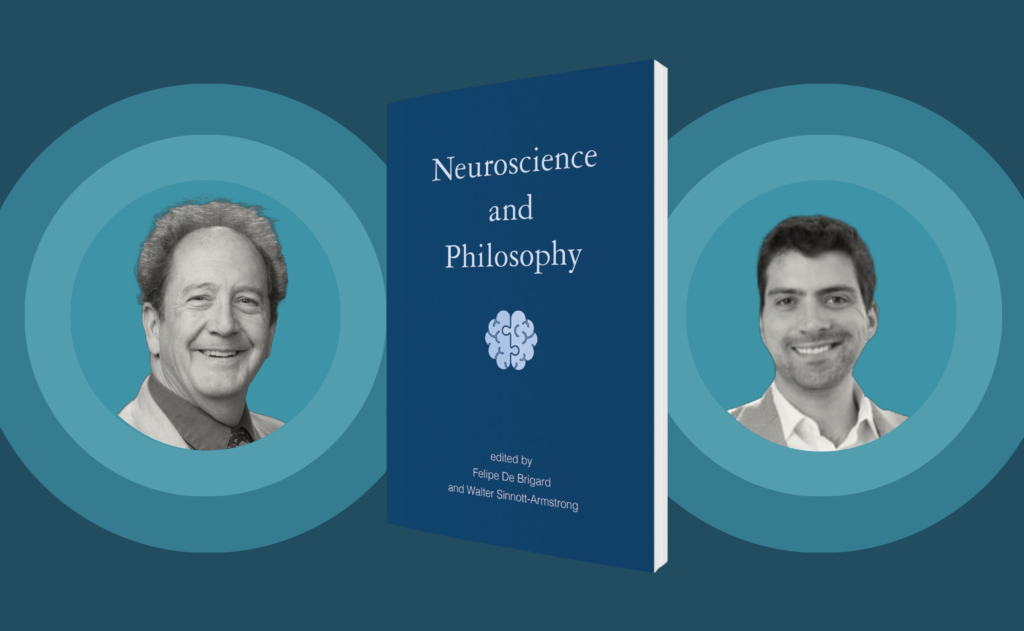
Headshots of Walter Sinnott-Armstrong and Felipe De Brigard

A recent publication builds on years-long collaborations between philosophers and neuroscientists, whose research seeks to answer questions about the human mind and how it works.

Kenan Senior Faculty Fellows Felipe De Brigard and Walter Sinnott-Armstrong are the editors of Neuroscience and Philosophy (MIT Press, 2022). The chapters explore a wide range of interdisciplinary questions, from “How do we decide how to act towards each other?” to “How do we remember and categorize what we experience?” Every chapter in the volume was written by a team with at least one philosopher and one neuroscientist.

These teams came together to study each others’ fields during the Summer Seminars in Neuroscience and Philosophy (SNNAP), which De Brigard and Sinnott-Armstrong organized and ran from 2016-2018. Many of them later collaborated on research projects, and returned in 2019 to workshop the resultant chapters in the book.

According to De Brigard and Sinnott-Armstrong, the book’s authors are “all future leaders in neuroscience and philosophy who will shape interactions between these disciplines for years to come. If you want to know how this interdisciplinary field will develop, they will show and tell you.”

The book was released in February 2022 and is now available for purchase.

The Summer Seminars will reconvene in 2022, and hold a closing conference on June 3–June 4. More information is forthcoming on the SSNAP website.

These seminars were funded by the John Templeton Foundation, with additional support from the Duke Institute for Brain Sciences and the Kenan Institute for Ethics.