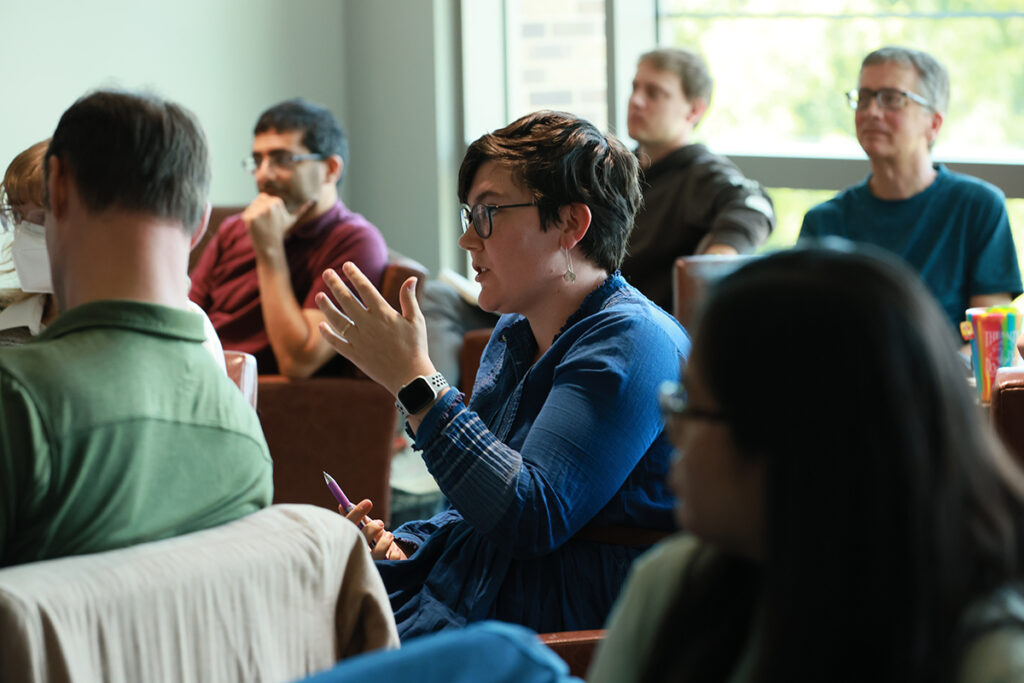
Professor Oca participates in a Character Forward seminar focused on how engineering faculty could incorporate character education into their courses. Photo credit: Alex Sanchez.
Professor Siobhan Oca teaches Duke engineering students that they will sometimes face moments when there’s not a clear way forward.
Through her Ethics in Robotics and Automation course at Duke, Oca dives into the ethical implications of engineering. She walks students through real-life examples, such as the Boeing 737 MAX crisis and hiring algorithm biases. Much like the engineers and executives of Boeing deciding whether or not to pull the planes after the two consecutive crashes, students are thrown into tricky situations where they must decide how to proceed.
Oca’s course asks students to rate themselves on virtues like trust and fairness, and consider how these virtues tie into the real-life decisions that engineers face. Engineering is not just about doing things perfectly, Oca says, but doing things responsibly —which means taking time to understand the ethical implications of their decision-making.
“Engineers want to work with facts and clear ideas. But the world is not binary. Teaching students to reason in the gray, together and across different backgrounds, may be the most technical thing we do.”
—Siobhan Oca
Oca’s work is part of the Character Forward, a partnership between Duke Engineering and The Purpose Project at Duke that seeks to incorporate ethics into the engineering curriculum. Funded by The Duke Endowment, The Purpose Project at Duke is a collaboration of the Kenan Institute for Ethics, Duke Divinity School, and the Office of the Provost.
Read the full article on the Pratt School of Engineering website.
Courtney Lewis poses superhero-style at the “American Indians Go Graphic” exhibit. Photo credit: Jared Lazarus/Duke University.
Located near the entrance of Perkins Library on Duke University’s West Campus, the Jerry and Bruce Chappell Family Gallery features a new exhibit each semester. This fall, that exhibit is “American Indians Go Graphic,” which features a collection of graphic art and comic books.
Along with Lee Francis, a fellow Ph.D. and comic book enthusiast, Courtney Lewis curated the exhibit to showcase works by American Indians about American Indians.
Lewis, Crandall Family Associate Professor of Cultural Anthropology and a citizen of the Cherokee Nation, launched the Native American Studies Initiative soon after arriving at Duke in 2023. In 2025, she expanded that initiative into a research program called RISE-US, or Research for Indigenous Studies and Engagement in the United States, at the Kenan Institute for Ethics.
Lewis says that “American Indians Go Graphic” shows that American Indian cultures are not simply a historical phenomenon — they are a vibrant and current way of life.
“One of the most important elements of comic books is that they inherently humanize American Indian peoples. This is incredibly important because American Indians are often portrayed only in the past, as if we are not active players in today’s society. Bridging this gap greatly increases the discussions we can have about American Indian lives and impacts on society, from economics to community responsibility.”
— Courtney Lewis
Lewis says she hopes that visitors will get a glimpse of Native cultures, heroism, and humor through this exhibit. On November 14–16, she is also excited for Duke to host IndigiPopX, an Indigenous pop culture convention featuring Indigenous celebrities, chefs, filmmakers, comic artists, game developers, fashion designers and performers.
To read Professor Lewis’s full interview about this exhibit and her work at Duke as a whole, visit Duke Today here.
On October 7, a crowd of Duke students, faculty, and community members filled the Karsh Alumni and Visitors Center to the brim to hear from Michael Sandel, a leading political philosopher and the Anne T. and Robert M. Bass Professor of Government at Harvard University.
In an event organized by the Department of Political Science and co-sponsored by the Kenan Institute for Ethics and the Provost’s Initiative on Pluralism, Free Inquiry, and Belonging, Sandel spoke about “The Tyranny of Merit: Can We Find the Common Good?” — his 2020 bestseller in which he offers different ways of thinking about success and who deserves it.
A student looks at a copy of Sandel’s book, “The Tyranny of Merit,” before the event’s start. Free copies of the book were available for undergraduate students. Photo credit: John West/Trinity Communications.
Sandel opened by explaining what he means by the “tyranny” of merit. He agrees that there is a level of merit necessary for a surgeon to successfully perform an operation on a patient. However, he argues that this merit doesn’t belong to the surgeon alone, but also to the many community members, mentors, and others who supported the surgeon along the way.
This runs counter to many of our popular assumptions about what merit means.
“An ethic of hard work and personal responsibility leads us to see ourselves as self-made and self-sufficient, which, after all, is a persistent temptation that’s in our common culture,” Sandel said.
According to Sandel, “a fully realized meritocracy is corrosive to the common good because it leads to hubris among the winners and to humiliation for those who lose out.”
In other words, so-called “winners” see themselves as deserving while looking down on those who they view as less successful. Perceiving this attitude, lower-income Americans feel resentful, deepening the social and political divide between the two groups.
Michael Sandel speaks at the event. Sandel was recently awarded the Berggrauen Prize for Philosophy and Culture. Photo credit: John West/Trinity Communications.
One of the biggest contributors to this divide, according to Sandel, is higher education.
“In the age of meritocracy, colleges and universities have come to be central institutions in the public culture,” Sandel said, “because they are the institutions that define the merit and confer the credentials that a market-driven meritocratic society honors and rewards.”
Sandel describes college as an elevator that higher-income people enter from the top floors, noting that higher-income applicants have much stronger chances of being accepted into the top twenty universities in the United States. However, despite these advantages, admission is still not guaranteed, so privileged kids are pushed to achieve high grades and test scores and participate in extracurricular activities to better their chances. Sandel said this dynamic creates “wounded winners” — privileged young people suffering from stress and burnout — while top colleges continue to be inaccessible to many lower-income students. Both end up harmed in the process.
Sandel then proposed a lottery system for college admissions. After narrowing candidates down to a pool of qualified applicants, students would be selected at random to receive offers of admission.
Some might argue that this makes the process overly reliant on luck. But Sandel says that luck already plays a big role in the admissions process — for example, a student born into a family with wealth and resources has a clear advantage going in.
The lottery system distributes luck in a more egalitarian way. It also makes it more visible. Since admitted students know that luck played a role in their admission, they don’t assume that they got in simply because they were better than the candidates who didn’t.
According to Sandel, this system benefits lower-income students by taking legacy admissions and expensive extracurricular activities out of the equation, while also removing some of the pressure for wealthy students to overcommit and overachieve.
Due to the large amount of interest in the event, the room was “standing-room only.” Photo credit: John West/Trinity Communications.
Along with Sandel, the event featured two respondents: Duke Professor of Law Jedediah Purdy and Danielle Sassoon, the former U.S. Attorney in the Southern New York district — who came to prominence recently due to her resignation from the high-profile Eric Adams case amid political pressure to drop the charges.
Sassoon came to the podium to offer a response based on her experiences. She said that her maternal grandparents were Hungarian Jews who came to America as refugees after surviving the Holocaust. Her grandfather provided for the family by working in a factory, where he was promoted to manager. Sassoon said that despite the many challenges he faced, his hard work helped her believe in the meritocratic system in America.
Although she agreed with several flaws in the college admissions system that Sandel highlighted in his opening remarks, including legacy admissions, Sassoon said she is not ready to abandon meritocracy. She pointed to the erosion of national unity and civic duty as the root cause of the divisions Sandel described.
In Purdy’s response to Sassoon, he discussed her role in the Eric Adams case. When Sassoon faced political pressure to drop the charges, she refused and resigned. Purdy complimented Sassoon for her actions. He connected this to the debate on meritocracy, arguing that her merit and sense of responsibility were not rewarded — instead, she was shunned by powerful institutions that opposed her decision.
Purdy also responded to one of the major points in Sandel’s book, which is that meritocracy obscures how globalization has led to widening wealth inequality, leaving many Americans behind. Sandel had earlier said that meritocracy provides “the rationale [and] specifications for the inequalities that photoshop [neoliberal] policies.”
Purdy agreed that meritocracy has brought us to a place which it is now difficult to untangle ourselves from. He concluded by emphasizing the need for cohesion and solidarity that reaches across class differences.
The speakers — Danielle Sasson, Michael Sandel, and Jed Purdy (right) — chat following the event. Photo credit: John West/Trinity Communications.
Catherine Papa smiles on the construction site where DukeEngage Eswatini helped build a water system for a primary school in the Herefords community. She says the most impactful part of the experience was spending time with the community. Photo credit: Louis Woofenden.
Catherine Papa T’27 always imagined that her Global Health and Biomedical Engineering majors would lead to an office job. But this summer, she spent most of her time outside with DukeEngage Eswatini, putting her knowledge to use in different ways.
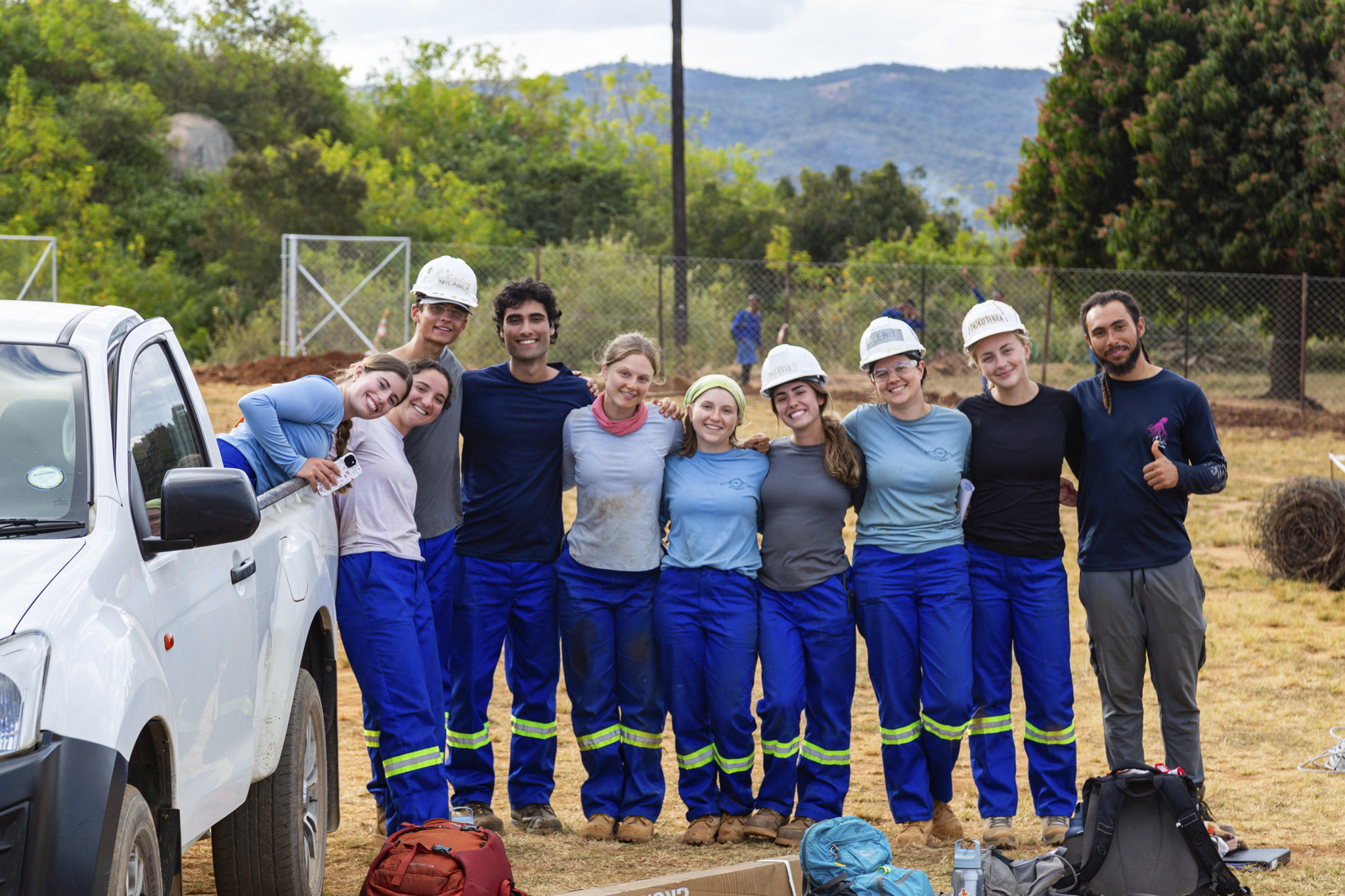
Along with other DukeEngage students and a group from Cornell University, Papa worked with Engineers in Action, local construction workers, and community volunteers to build a water system for a primary school in the Herefords community in the Hhohho region. The team also established sustainable methods to maintain the system so that it can continue to function and provide clean water for students and teachers for years to come.
While Papa knew she was doing important work, she says that spending time in the community was the most impactful part of the program for her — whether cheering on community members who were playing in a soccer game or joining them at the dinner table.
Papa says that the experience also caused her to reflect on her privilege as someone with access to far greater resources than many of the people around her, simply because of where she was born.
“To understand the inequality in the world as a concept is one thing, but to sit across from someone at the dinner table who you have come to see as a friend, and to see the inequality between the two of you just because of the country you were born in, is entirely more personal.”
— Catherine Papa
As one of the site’s Project Managers, Papa expressed gratitude for community volunteers and fellow student workers at a celebration event for the new water system, which was covered by Eswatini Positive News.
To read Papa’s short profile, visit the Duke Global Health Institute website, where they recently published her story alongside profiles of four other committed global health undergraduates.
The group of DukeEngage students worked alongside Engineers in Action, students from Cornell University, local construction workers and community volunteers to build the water system. DukeEngage Eswatini was directed by engineering professor David Schaad, who has led DukeEngage programs around the world since the program’s inception. Photo credit: Louis Woofenden.
Kenan Institute for Ethics Senior Faculty Fellow Rebecca Vidra recently published an op-ed in Inside Higher Ed on her plans to incorporate character education into her courses — not only for her students, but also for herself.
Vidra, Senior Lecturer in Marine Conservation and Ethics in Duke’s Nicholas School of the Environment, describes character education as the practice of helping students develop intellectual virtues like curiosity, humility, and resilience.
Using strategies from the Institute for Social Concerns at the University of Notre Dame and the Greater Good Science Center at UC Berkeley, Vidra plans to include the development of intellectual virtues as a learning objective on her course syllabi and incorporate reflection exercises to help hone students’ sense of purpose.
Vidra writes that she hopes that she will be able to practice these intellectual virtues through her teaching, too.
“I am actively working to cultivate my own resilience, my own ability to keep showing up as a facilitator with curiosity and humility. I am preparing to practice what I teach.”
— Rebecca Vidra
Vidra will be supported in her efforts through a grant from the Educating Character Initiative at the Program for Leadership and Character at Wake Forest University.
In June 2025, she also received an Emerging Pedagogies Grant from Duke Learning Innovation and Lifelong Education to “investigate the ways in which Duke’s Masters of Environmental Management (MEM) students currently explore their purpose and identify innovative strategies for further integrating purpose work.”
As a new Kenan Senior Faculty Fellow, Vidra will serve as a liaison between The Purpose Project at Duke and the Nicholas School of the Environment, and will develop an undergraduate course related to the aims of The Purpose Project.