
Annual Report
2025–2026 ACADEMIC YEAR
FROM THE DIRECTOR
On September 2, 1791, Thomas Jefferson and James Madison set out from Philadelphia for Monticello in a four-horse carriage. Jefferson recorded the details of their trip, noting stops for food and lodging, the nature of the terrain, and mileage. The 266-mile trip took ten days. Today you can make the trip in less than five hours.
Writing in 1934, Frank Dobie captured the impact of this shift in time and travel: “The rule is simple: the more machinery man gets, the more machined he is. When the traveler got off a horse and into a machine, the tempo of his mind as well as his locomotion was changed.”
As we celebrate the nation’s 250th anniversary, it’s worth remembering that the Declaration of Independence and the U.S. Constitution were the products of minds keyed to the tempo of horses, not to the tempo of smart phones and artificial intelligence.
Continue Reading
Someone asked me a few months ago if the varied programs of the Kenan Institute for Ethics share something fundamental. They do. Amid deepening economic, political, and cultural divides and rapid advances in artificial intelligence, our programs seek to slow the tempo of the mind.
We don’t know what Jefferson and Madison talked about over ten days of travel. Perhaps it was one of the two hundred books Jefferson had sent Madison from Paris a few years earlier, which were instrumental in Madison’s drafting of the Constitution; perhaps it was the not-yet-ratified Bill of Rights that Jefferson had supported and Madison had originally opposed. What we do know is that they had plenty of time for conversation about the challenges facing a new nation.
The programs you will encounter in this annual report—courses, fellowships, immersive experiences in community, moderated conversations for the public, storytelling for broad audiences—display the Kenan Institute’s commitment to creating structured spaces that slow the tempo of the mind and enable the conversations we need to have about the state of the nation, and the state of world in which it stands. Such conversations require patience, which means they take time, the kind of time that was once built into the structure of the world by our means of travel but has now all but disappeared into the ether of cyberspace.
I’m fond of quoting a colleague who says, “Ethics happens by participation.” Participation takes time. It takes time to read a book, to write a paper, to listen attentively to those with whom you disagree, to deliberate and find a way forward. It will also take time to read this report, so whether you are a student, parent, faculty member, or someone who simply wants to learn more about us, thank you for spending time with the Kenan Institute for Ethics.

David Toole
Nannerl O. Keohane Director

Good Life
What kind of person do you want to be?
We offer programs that push students out of their comfort zones, making them more open to new experiences and new perspectives. We encourage them to prioritize both academic and personal growth, learning new concepts and skills while also thinking about the person they’re becoming in the process. No matter what they study, we help them find its connections to ethical questions — ones whose answers will continue to shape the person they become long after they graduate.
We don’t just help undergraduates to succeed at Duke — we help them figure out what they value and what success means to them.
“It’s challenged me in ways I didn’t think I could challenge myself before. I’ve experienced things that I never would have thought I would experience in my four years at college.”
Connor Melehan T’28 is talking about Capacious Minds Fellows, a pilot program launched by the Kenan Institute for Ethics in 2025. An experimental yearlong fellowship designed by former civil rights lawyer and choreographer Brooks Emanuel, Capacious Minds Fellows asks students to expand their minds — and even their notion of what a mind is — through activities centered on embodiment, play, and wonder.
If it all sounds a bit mysterious — that’s the point. The fellows never knew exactly what they would be doing week by week.
Continue Reading
One session that focused on movement exercises put them well outside their comfort zones — even the students with backgrounds in dance.
“There were a couple shared glances between everybody in the group, like, ‘are we really doing this?’” Melehan jokes.
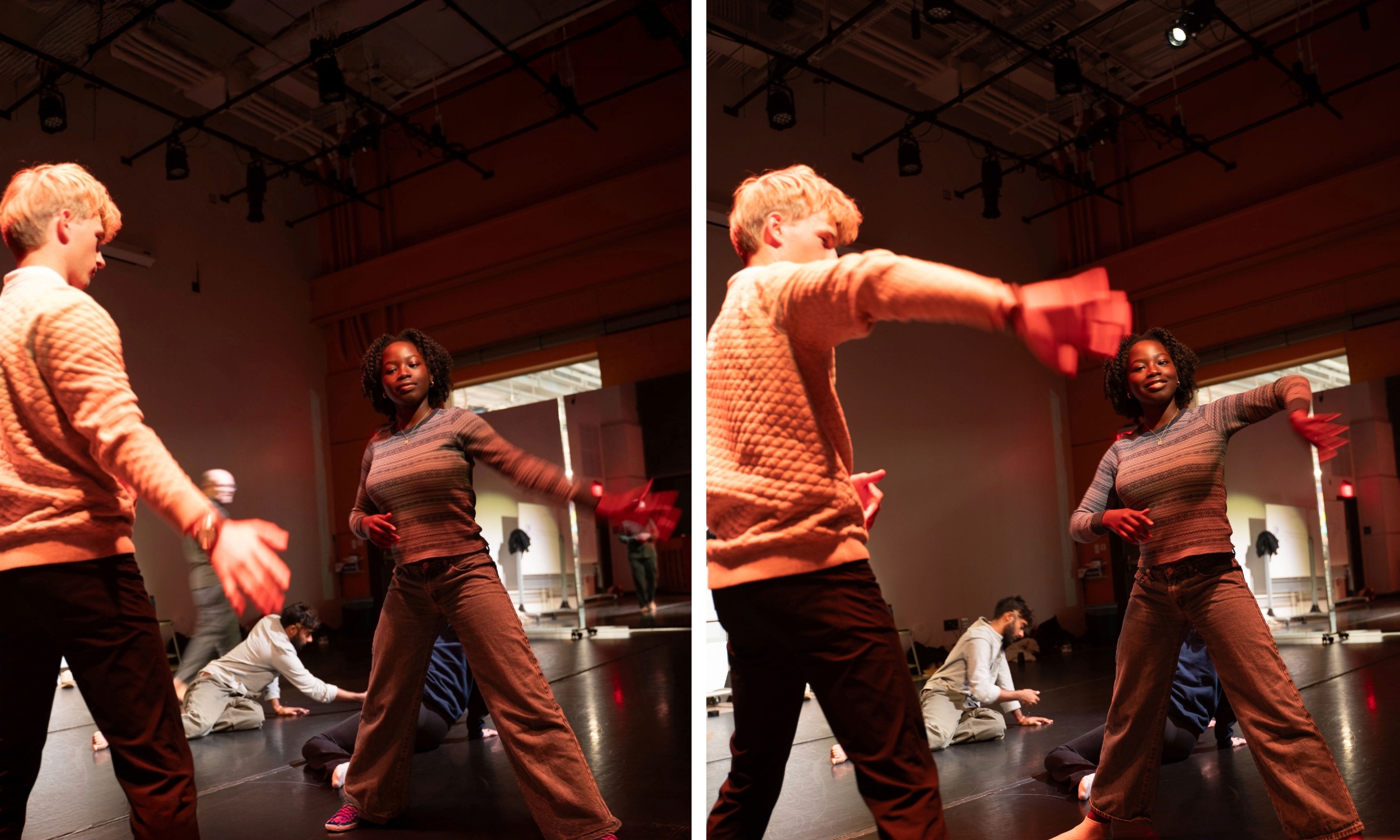
But he soon found that he gained a lot of “comfort with discomfort” as he said yes to new experiences, week after week.
Through cultivating open-mindedness — and sharing experiences in which everyone felt a little vulnerable — the fellows developed unusually strong bonds with each other.
“The program evolved from building these ‘capacious minds’ to having really insightful conversations and growing as a group,” Melehan says. “We’re pushing each other to grow, be it through shared values or even the areas where we disagree.”
This not only made the students more comfortable disagreeing with each other, even on topics they felt passionately about, but encouraged them to lead with curiosity — and always put each other’s humanity first.
“The way you value them, the way you care about them, and them being another human being always supersedes any sort of disagreement,” Melehan says.

His experiences started to influence his decisions outside of the fellowship, too. For example, he chose a living situation where he would have to practice speaking Spanish during a summer study abroad program.
“When I had the choice between a homestay or a residence hall…I thought, ‘You know what? Why not the homestay?’” he says. “There’s a wealth of growth in that discomfort.”
Through intentionally slow-paced activities and weekly reflections, Capacious Minds Fellows also helps students practice attunement — to others, to the world around them, and to themselves.
During his second semester in the program, Melehan realized he was rethinking his path at Duke.
“I spent the first three semesters at Duke trying to make myself look as good as possible for law school applications, when I had zero desire to be a lawyer,” he says. “You end up so busy that you don’t give yourself the time to actually think about why you’re pursuing something or if you even want to pursue it.
“And I think that’s one of the most dangerous traps that exist at a school like Duke,” he continued, ”where you come in already feeling behind. And so you pour all of your time and energy into catching up…until you have a second to breathe and realize, ‘Wait, I don’t want this.’”
One day, while studying for the LSAT in his dorm, Melehan suddenly thought, “Wait, why am I doing this?”
He closed the book, looked at the wall, and thought for an hour before he realized, “This isn’t what I want to do. I need to keep digging.”
“Capacious Minds has qualitatively changed me...It’s made me more comfortable with the unknown, and more excited to pursue areas that can propel my growth.”
While Capacious Minds Fellows didn’t give Melehan the answer to that question, it did give him the confidence to sit with uncertainty until he figures it out on his own.
“Capacious Minds has qualitatively changed me,” he says. “It’s made me more comfortable with the unknown, and more excited to pursue areas that can propel my growth.”

Engineering courses are notoriously challenging, but what if they also challenged students to become better people?
In Engineering 101, an introductory course for first-years that focuses on design and technical communication, professors Michael Rizk and Ann Saterbak ask students to develop not only their STEM skills but also their character.
Continue Reading
This course is part of Character Forward, a partnership between Duke’s Pratt School of Engineering and The Purpose Project at Duke, a collaboration between the Kenan Institute for Ethics, Duke Divinity School, and the Office of the Provost. Character Forward seeks to integrate purpose and integrity into the engineering curriculum.
Dr. Rizk says that he saw this course as an opportunity “to be a part of students’ lives as they figure out what they want to do in life and what’s important to them.” In addition to helping them develop good habits as engineers, he hopes to help them shape their values and aspirations in everyday life.

Rizk worked with the Character Forward team to emphasize valuable character traits during each stage of course projects, such as team formation, ideation, prototyping, testing and result-sharing.
For example, team formation requires respect, especially when students come from different backgrounds or have different lived experiences.
The instructors gave examples of how teams could foster respect before the phase even began. Students later created video reflections to share what they learned throughout their projects and how it applied to their personal lives.
A Kenan Institute for Ethics assessment team found that 80% of students had a positive view of the focus on character in their course.
One student, Daniel Matten E’28, said that the character exercises were instrumental in bringing his group together.
“Although I knew we were all smart people, I was initially concerned about the group dynamics given our various backgrounds and leadership styles,” he said. “The character reflections encouraged by the instructors and TAs sparked the conversations that we needed to have as a group and pulled us much closer together.”
Other students echoed that the communication and teamwork skills that they learned in the course would stay with them long after they received their final grade.
Rizk says that the Pratt School of Engineering is defined by the kind of people it sends out into the world. He is proud of the work he has done with the Character Forward Initiative and optimistic about the future of his Engineering 101 students.
Ph.D. student in Religious Studies Claire Rostov received the 2026 Dean’s Award for Excellence in Teaching from Duke Graduate School — and she credits her involvement in teaching programs, including Teaching on Purpose, in shaping her teaching style.
Directed by Katherine Jo, Teaching on Purpose is a fellowship program that encourages doctoral students to grow as educators of undergraduates — in part, by reflecting on how their discipline connects to questions of meaning and purpose. It is part of The Purpose Project at Duke, a collaboration between the Kenan Institute for Ethics, Duke Divinity School, and the Office of the Provost.
In this interview, Rostov talks about how Teaching on Purpose challenged her to try new things in the classroom — like having students open the class discussion and asking questions that helped connect the course content to students’ lives.
Continue Reading
Why did you choose to participate in the Teaching on Purpose Fellowship?
There’s lots of really practical parts of teaching, like “How do you make a syllabus?” and stuff like that, but I was excited to think a little bit more about the big picture: what are the big questions and the ways in which we are teaching in a broader college context.
What were the biggest things that you took away from the fellowship?
Teaching on Purpose really helps you think about how your role teaching your one class is such a small part of the bigger institutional context, and also all of the things happening in students’ lives that really extend beyond your class that you’re teaching.
We spent a lot of time in Teaching on Purpose thinking about how to connect the course content that we’re teaching with questions and interests students have: how do we ask questions and make connections between the content we’re teaching and students’ lived experiences and things they care about.
I’m in Religious Studies, so sometimes the things I’m teaching feel really relevant and timely, and other times we’re talking about 18th century sermons, and it’s like, how does this matter to a Duke student in 2026? Thinking about how to make those connections relevant was helpful.
How did you feel when you found out that you received the award?
It was really touching to receive the award. A lot of the course evaluations that students wrote were, I think, a big reason I got it.
So much of teaching is just experimenting. You try something in the classroom, sometimes it goes well, sometimes it doesn’t. There’s some value in just continuing to experiment and try new things in the classroom. It was nice to just get the award and have that be acknowledged.
“Teaching on Purpose inspired the confidence to just try some things, and to do something experimental or new. That made for a much better classroom experience and a better learning environment.”
How did Teaching on Purpose change your approach to teaching?
If a class is an hour and 15 minutes, and you show up with an hour and 15 minutes of lecture notes, you know exactly how the class is going to go, and that’s easy in a lot of ways. It takes off the stress of the unknown.
It’s much harder to relinquish that control and do interactive activities and group discussions, because you don’t actually know how it’s going to go. Teaching on Purpose inspired the confidence to just try some things, and to do something experimental and new. That made for a much better classroom experience and a better learning environment.
In Teaching on Purpose, we talked about having questions that help relate the course content to students’ own lived experiences and lives. Each day in my class, there was a question on the syllabus and students were discussion leaders, so for the first 10 minutes, different students would run discussions on those questions. Across the board, that was what students liked most about class — this moment in which their classmates were getting to run the discussion.
That was what I took directly from something we’d done in Teaching on Purpose, having these questions that would relate the content to students’ lives.
MORE GOOD LIFE MOMENTS
Good Community
How do you want to show up in the world?
Community engagement asks students to put ethics into practice. Our partnerships with on-the-ground organizations allow students to step into ongoing projects, supporting others’ priorities rather than their own. By developing relationships with people from different backgrounds and solving problems in unfamiliar contexts, students also expand the boundaries of their potential for growth.
This shift sometimes leaves them feeling out of their element — and less successful than they’re used to feeling. But through these challenges and setbacks, students develop their sense of agency, giving them both a clearer vision and more concrete plan for the impact they want to make in the world.
Many students covet the experience of a semester abroad in France.
But Saint-Avold, a small town in the northeastern region of France, is “not Paris,” according to Martin Heintzelman T’26.
In this case, that’s a good thing.
Heintzelman says the experience of spending time in a small French town, where local residents recognized him in the city square and the newspaper reported several times on the “étudiants de Duke” in the community, was an opportunity to “really immerse” himself in a different culture.
Continue Reading
Students also had the chance to support organizations working to improve life in the community — one that has struggled to find a new economic footing since the closure of the region’s coal mines twenty years ago.
During their eight weeks in Saint-Avold over the summer of 2025, DukeEngage students worked with several community partners addressing ongoing economic and social challenges. They assisted in workshops refurbishing furniture for families in need, supported a wool workshop providing vocational training, and led sports and music activities for schoolchildren. Students also contributed to physical improvement projects around the town, painting and restoring public spaces and helping to develop a guide encouraging businesses in the town center to add plants and flowerbeds by their storefronts.

“I think everyone who has a chance to do something like this, whether it’s here or in the U.S. or another country, should really take advantage of it.”
A lot of the value of their DukeEngage experience came from their informal interactions with community members, students said.
“It felt like we’ve had the opportunity to go in a community and just be with them and experience things with them, which has had a lot more impact on how I can connect with them,” said Quindlan Kelleher T’27.
“I think everyone who has a chance to do something like this, whether it’s here or in the U.S. or another country, should really take advantage of it,” Heintzelman said. “We’ve just gotten to meet so many really interesting and cool people, and build relationships that would not occur in everyday life, in terms of across age gaps, or socioeconomic status, or education level.”
The program was directed by Germain Choffart, a Lecturing Fellow in Romance Studies at Duke who grew up in Saint-Avold. Choffart was able to connect with local organizations through his mother, a former social worker. This allowed students to work on projects that were ongoing and prioritized by community partners.
While Choffart said that this year’s students “have set a high bar” with their hard work and good attitudes, he plans to offer the program again next year, giving another group of students the chance to immerse themselves in a new place, and — like the DukeEngage motto says — “challenge themselves and change their worlds.”

When asked why they applied to DukeEngage, students often say they want to “make an impact.”
In DukeEngage Uganda, that impact might be helping local hospitals to save lives.
This program pairs engineering students from Duke and Makerere University to design medical devices to address local healthcare facilities’ unmet needs.
“I’m so glad I came, because we got the really, really special opportunity to…build solutions that will directly be helpful for hospitals here on the ground,” said Chris Wyrtzen E’26, who participated in DukeEngage in 2025.
Continue Reading
Dr. Ann Saterbak of Duke’s Pratt School of Engineering developed the program with Dr. Robert Ssekitoleko of Makerere University after seeing “graveyards” of Western medical devices lying unused in Ugandan hospitals. While donated with good intentions, this equipment doesn’t work well in the Ugandan context, where power supply is unstable and it’s often difficult to obtain the materials for repairs.
For this reason, the Duke-Makerere student teams design devices that only use low-cost, readily available materials.
Dr. Ssekitoleko is convinced that working with limited resources spurs innovation and creativity. As an example, he pointed to the no-frills makerspace where the Duke and Makerere students design their prototypes — the Design Cube.

But in spite of its limitations, many of the devices that originated in the Design Cube are not only functional, but inspiring — like the NeoNest, a warming device that keeps premature infants at safe temperatures while they’re being transported to health facilities.
Vivian Arinaitwe, a member of the team that developed the NeoNest device, said that Duke and Makerere students bring different skills and capacities when it comes to addressing healthcare challenges through design.
“The students from Duke University have had the chance to learn and use sophisticated equipment and get very many skills that they could utilize in this program,” Arinaitwe said. “The Makerere University students have the expertise in understanding the context, understanding the healthcare system, and easily collaborating culturally with different healthcare facilities and personnel. So bringing these two together and merging them helps us to build a solution to a healthcare problem that is not only contextually appropriate, but also sophisticated to the context that we are building it in.”
While these devices offer promising solutions, Dr. Ssekitoleko offered a disclaimer: engineering takes time. In this context, he said, four years is considered a short time to bring a device to market.
But he noted with pride that three devices from the Design Cube have gone on to win prizes at international engineering competitions.
“I’m so glad I came, because we got the really, really special opportunity to…build solutions that will directly be helpful for hospitals here on the ground.”
Duke and Makerere students also said that they’ve learned that engineering goes beyond the product — it’s also about the process. And connecting with their teammates is an integral part of it.
“I hope to take [away] valuing people and relationships more than the product moving forward,” student Chris Wyrtzen said, “because I’ve realized how much people really prioritize each other here and love each other really well.”
How can students get the most out of their DukeEngage experience?
A key component of all DukeEngage programs, reflection helps students to derive meaning from their experiences. DukeEngage offers a reflection challenge each year, with submissions ranging from essays to oral stories and even poetry. Students share their reflections at the DukeEngage Fall Reunion.
Continue Reading
For her spoken word piece after participating in DukeEngage Chicago, Tashiel Reid T’27 won the Culture and Humility category in the 2025 DukeEngage Reflection Challenge.
Judges said they were struck by the honesty in the way Tashiel acknowledged her own preconceptions, and admired the way she let the realities of her community sink in, inspiring both inward and outward growth.
“No one gets to choose where they’re born,
Decide who their parents will be,
Control the zip code from which they were weened.
But more often than not
This determines the life that you get to live,
The privileges you get to receive…
So my hope is: we embrace art in these communities,
Heal their traumas internally.
Because the arts really should be for everybody.”
DukeEngage 2025 Program Locations

DukeEngage Marine Lab
DukeEngage Miami
DukeEngage Virgin Islands
DukeEngage Boston
DukeEngage Durham
DukeEngage DC: Democracy
DukeEngage DC: Science & Tech
DukeEngage Chicago
DukeEngage Orange County
DukeEngage Eswatini: Bridge
DukeEngage Eswatini: Water Sanitation Hygiene
DukeEngage France
DukeEngage Panama
DukeEngage Colombia
DukeEngage Ghana
DukeEngage Greece
DukeEngage Korea
DukeEngage Senegal
DukeEngage Cape Town
DukeEngage Uganda
DukeEngage Brazil
DukeEngage Jordan
MORE GOOD COMMUNITY MOMENTS
During a trip to Durham the summer before entering Duke, incoming first-year students in the Gateway program learn about the ethics of community engagement — in this case, by sorting donations at local organization TROSA.
Local high school students joined a discussion with actor Mike Wiley before a performance of “Changing Same” at the North Carolina School of Science and Math. The America's Hallowed Ground team developed a curriculum around the play, which focuses on a Black soldier, Booker T. Spicely, who was murdered by a bus driver in Durham in 1944.
The Kenan FOCUS cluster "Free for All: Freedom, Justice and Citizenship" offers first-year students a whirlwind weekend trip to Washington, D.C. Students praised the program as a great way to build community during their first semester.
Good Society
What kind of world do we want to build together?
Understanding how to build a better world also requires understanding how institutions shape our collective life. Hearing from people whose lives have been directly impacted by institutions can challenge our assumptions about how they work — and whether they work fairly. Until we take a step back and view them critically, these structures seem as natural to us as water is to fish.
Through creating spaces for this kind of ethical engagement — whether in courses, public events, or storytelling — we bring research and lived experience into conversation, helping us to both better understand institutions and imagine alternative possibilities.
While Will Lieber and Jenna Smith came to Duke with interests in criminal justice and incarceration, one course ended up shaping their paths in unexpected ways.
“This class influenced the framework through which I analyze the world around me,” Smith said. “It was honestly like a life-defining thing for me, or really life-influencing.”
“This class certainly informed the trajectory of my path at Duke,” Lieber agreed, noting that he designed his own major in Health and Incarceration after taking it.
After taking the course, the students strengthened their commitments to helping incarcerated people through volunteering, advocacy, and leadership.
Their extraordinary efforts were also recognized with one of the most prestigious awards in the world — the Rhodes Scholarship.
Continue Reading
Smith was named a 2025 Rhodes Scholar; Lieber, a 2026 Rhodes Scholar. Both plan to pursue master’s degrees in criminology and criminal justice at Oxford.
The course? “Just Work: Restorative Justice Models and Applications,” taught by Kenan Institute for Ethics Associate Director Ada Gregory.

“The questions that you get to ask in restorative justice are ones that will carry through to how you engage in your personal life, in your professional life, and how you engage in conflict in any capacity.”
In contrast to the typical criminal justice process, which focuses on punishment, restorative justice is a voluntary process that seeks to repair the harm caused by the crime.
This fundamental shift tends to challenge what people think they know — or have unconsciously internalized — about the way the criminal justice system works.
“The central question is, ‘What is it that we owe each other?’” Lieber said. “And it’s really difficult to figure that out. And that’s a very personal and unique question. That’s why restorative justice is so powerful — because it is personalizable and a unique form of adjudicating justice.”
“The questions that you get to ask in restorative justice are ones that will carry through to how you engage in your personal life, in your professional life, and how you engage in conflict in any capacity,” said Smith.
When Lieber and Smith talk about Gregory’s course, it’s clear that it wasn’t only the content that affected them, but also the way she taught it.
Both praised the way that Ada Gregory, a former police officer, led the course discussion. Much of it was structured in restorative justice “circles” — facilitated dialogues in which everyone has the chance to speak, and listening to understand, rather than debate, is a shared value.
It was also far more diverse than the typical Duke class. It included several volunteers from the local organization Restorative Justice Durham, whom Smith jokingly called “real adults.”
“Getting to engage in those conversations not just with our peers in the classroom but our community members in Durham was part of why I found the class so engaging,” Smith said. “It was the catalyst for me trying to engage more with opportunities outside of Duke for the rest of my time here.”
Both students continued to engage with the criminal justice system during the rest of their time at the university.
Lieber began volunteering at Butner, a local federal correctional complex. He and Smith also took a Duke Divinity School course at Butner, “Life Stories,” that brought Duke and incarcerated students together.

“You come to college to meet people who are different from you. And people in prison have so much to share that will fundamentally alter how students think about the world and how they think about the justice system.”
“You come to college to meet people who are different from you,” Lieber said. “And people in prison have so much to share that will fundamentally alter how students think about the world and how they think about the justice system.”
The students became more involved in the local community, volunteering at organizations like Restorative Justice Durham and StepUp Durham, which offers re-entry programs for formerly incarcerated people.
They took on leadership roles in the student-run organization Duke Justice Project. Smith spearheaded its Advocacy Week, which brought a replica of a solitary confinement cell to the Bryan Center Plaza to increase awareness of prison conditions.
Along with Viktoria Wulff-Andersen, Lieber and Smith co-taught a house course focusing on re-entry programs in Durham, bringing in local guest speakers with whom they’d developed relationships through their volunteer work.
Through the house course, they were proud that they were able to reach students who might not have otherwise engaged with the criminal legal sphere.
“We really wanted to emphasize that, regardless of what space you are in, this should be in your mind,” Smith said. “This is something that impacts you as well.”

Imagine getting the chance to fix your biggest mistake. All you need is ten minutes of your life back.
Jens Ludwig says that 80% of the people incarcerated for gun violence would not be in prison if they had that chance.
Ludwig is the Edwin A. and Betty L. Bergman Distinguished Service Professor at the University of Chicago’s Harris School of Public Policy. His research shows that most deadly shootings in the U.S. aren’t premeditated acts of murder — instead, they’re due to conflicts escalating in the moment.
Continue Reading
As part of the Ethics of Now, an event series from the Kenan Institute for Ethics, Ludwig visited Duke and Durham to talk about how he analyzes gun violence through the lens of behavioral economics, a branch of economics that seeks to better understand human decision-making. He spoke to students at Duke Law School and the Department of Economics before joining Ethics of Now host Adriane Lentz-Smith for a public event at the Durham County Main Library on the evening of January 23.
In his book, “Unforgiving Places: The Unexpected Origins of American Gun Violence,” Ludwig writes about two Chicago neighborhoods, Greater Grand Crossing and South Shore. These communities are right next to each other. They are indistinguishable in terms of demographics and economic conditions. Yet, despite their proximity, Greater Grand Crossing has twice as many shootings as South Shore. Why?
Located by Lake Michigan, South Shore has more commercial development, which means there’s more foot traffic and what Ludwig calls “eyes on the street.” Since most shootings are the result of split-second decisions in moments of high stress, Ludwig says, bystanders have a deescalating effect.
Additionally, according to research from the Crime Lab at the University of Chicago, which Ludwig directs, neighborhoods plagued by gun violence keep losing residents, because they leave to find safer places to live. So the cycle of violence deepens and the problem only gets worse.
Ludwig discussed his research with a group of Duke undergraduates in the Social Sciences building — the same building where he earned his Ph.D. in Economics from Duke Graduate School over 30 years ago.

Ludwig said that while the gun violence problem is much bigger and more complex than national policy would have you assume, there are much less costly solutions than what is proposed.
Since 90% of shooters and 80% of victims have prior records, Ludwig said, training detention guards to teach behavioral intervention methods is an effective way to curb violent crimes. Empowering high-risk people to make smarter decisions instead of escalating conflict to the point of no return is an inexpensive but practical solution.
“As we learn more about how the world works, it turns out that you can really reduce violence without having to incarcerate lots of people,” Ludwig said.
When a student asked whether these interventions would have similar outcomes in different regions, Ludwig said yes. “Policy-makers assume absolutely nothing generalizes,” he said, but “the things that work are much less context-specific than policy-makers assume.”
“As we learn more about how the world works, it turns out that you can really reduce violence without having to incarcerate lots of people.”
Ludwig later visited the Durham County Main Library to speak to the Durham community about gun violence. He reiterated his point about the importance of behavioral interventions while diving deeper into the psychological mechanisms of these life-altering decisions.
When the brain is under stress, like the stress of intense interpersonal conflict, Ludwig says that deliberate “System 2” thinking turns off and automatic “System 1” thinking takes over.
“System 1 is designed to be very fast…choosing between two options: ‘fine’ and the ‘end of the world,’” Ludwig explained. These instant decisions can lead to the heat-of-the-moment violence, especially in vulnerable communities.

“There is a second group of people that is often engaging in high-stakes situations where misconstrual and catastrophizing also turns out to be important, which is law enforcement,” Ludwig said.
He described how a University of Chicago research colleague delivered behavioral training to a thousand Chicago police officers, “then looked at their administrative activity data six months later.” In comparison with a control group that didn’t receive the training, there were reductions in their “use of force, low public safety value arrests, and black-white disparities in low public safety value arrests as well.”
In the Q&A session, Durham County Commissioner Michelle Burton asked for practical steps that she and her fellow policymakers in Durham could take to fight gun violence. Ludwig mentioned training detention guards to provide behavioral intervention education, but also focusing on city planning. Creating vibrant neighborhoods entices people to go for a walk or drive around the block, which decreases the likelihood of violent crime by 30%.
Other questioners led Ludwig to emphasize the importance of a good social safety net, education, and a variety of policies that can target different aspects of the gun violence problem.
The newest season of the documentary podcast “Scene on Radio,” produced by the Kenan Institute for Ethics at Duke University in partnership with PRX, is an official selection of the 2026 Tribeca Festival.
Hosted by John Biewen and co-hosted by Chenjerai Kumanyika with story editor Diana Hodson, “The News” does a deep-dive into the current state of the media and the public’s declining trust in traditional news organizations, and offers insights into what a more democratic media might look like.
In this interview, “Scene on Radio” host and producer John Biewen talks about how he ended up working and teaching at Duke, how he developed a podcast that takes deep dives into big issues, and why he’s happy to be at the Kenan Institute for Ethics.
Continue Reading
How did you end up at Duke after a decades-long career in audio journalism?
I arrived in Durham and at Duke in 2001, but I wasn’t working for Duke yet. At that point, I was still working in the public radio system for American Public Media. The Center for Documentary Studies provided me with office space, and after some conversations with Tom Rankin, who was CDS director at the time, I became director of the audio program in 2005. I managed to create a job for myself that I liked even better than the one I had — being employed by a university to produce audio documentary work for the public radio system. I was in that job for 18 years, and it involved teaching audio documentary courses to Duke undergrads, graduate students, and continuing education students.
In 2023, I was lucky to move to the Kenan Institute for Ethics, doing similar work to what I was doing at CDS; namely, producing “Scene On Radio” and teaching Duke courses in Documentary Studies, Ethics, and Journalism and Media.
When did you come up with the idea to launch a podcast, and how did it evolve over time?
My whole career had been producing for public radio programs and networks, but there were a lot of constraints there in terms of time and format. And then with the explosion of podcasts after “Serial” (2014), I realized, okay, you can have your own thing, with editorial control and creative freedom.
I had this idea to do a season on whiteness and white supremacy, because of some things that were happening in the world and some things that had been nagging at me for a long time. “Seeing White,” our second season, came out in 2017, and that really shifted my thinking about what “Scene on Radio” was and what it was going to be.
That was the result of two things. Certainly, the response was not what I expected — the very tiny audience that “Scene on Radio” had in 2016 grew by ten, twenty, fifty-fold. And then also just how satisfying that work was, and how much I learned, and it was like, oh, I could do this, because of the wonders of the podcast series format, where it’s roughly akin to writing a book. You spend a year and a half or so doing a whole bunch of research and a bunch of interviews, and take listeners on a journey through a very big and complex topic.
It was really a gift that there I was, in my 50s, and it was like, oh, this is a different approach to the work that I just love. And it became, from that point on, these deeply researched, season-long series on huge and audacious topics.

"Ethics is just everywhere in the issues that I’m exploring. It’s really at the core of a lot of the work that I’ve done for a long time, which is — how do we create a society in which people can live together and create a better world for ourselves?"
How is producing audio documentary different from traditional journalism?
One definition of documentary that I like — it’s not mine, somebody else said it — is, “Documentary equals journalism plus art.” I don’t know if the definition encompasses audio documentary, but it’s a useful one.
There’s the research and the reading, and setting up interviews with experts and with regular people, and writing and editing the script, and working with the team, but maybe the most pure joy that I have in doing this work is in the crafting of the audio. You’re sitting there moving sound around on the screen, and deciding on the pacing, and which piece of music to use, and exactly when to bring it down, to the tenth of a second, to make the experience for the listener as inviting as possible. That’s my absolute favorite part of the work.
How do you see your work fitting into the mission of the Kenan Institute for Ethics?
I’ve long been interested in this tension in the documentary world, where there are people who are absolutely committed to doing documentary work that is addressing issues in the world, and then there are other people who are just primarily interested in working with the form, and they’re not so concerned or are maybe even turned off by the idea that you’re trying to make the world better. Obviously, it’s a spectrum — it’s not just two camps.
But I have tended to be, for the most part, in the first camp. Ethics is just everywhere in the issues that I’m exploring. It’s really at the core of a lot of the work that I’ve done for a long time, which is — how do we create a society in which people can live together and create a better world for ourselves?
So yeah, Kenan is absolutely a fit. It’s an absolute honor to be associated with this place, and to have my work associated with that mission.
MORE GOOD SOCIETY MOMENTS
THE PEOPLE BEHIND THE PROGRAMS

Brooks Emanuel
Capacious Minds Fellows

Rich Eva
Character Forward

Katherine Jo
Teaching on Purpose
“What Should I Do With My Life?“
See All

Warren Kinghorn
Re-Imagining Medicine

Victoria Yunez Behm
Re-Imagining Medicine

Christine Folch
DukeEngage

Inga Peterson
Elena Hammann
Kristin Wright
Christine Meyer-Patel
DukeEngage

Dagny Edison
Shannan Hayes
Kristin Wright
Elena Hammann
DukeEngage Gateway

Charlie Thompson
Mike Wiley
America’s Hallowed Ground

Kendall Surfus
Lindsay Huth
America’s Hallowed Ground

Eric Mlyn
FOCUS
Free for All: Freedom, Justice & Citizenship

Jesse Summers
FOCUS
Free for All: Freedom, Justice & Citizenship

Juliette Duara
FOCUS
Free for All: Freedom, Justice & Citizenship

Ada Gregory
FOCUS
Free for All: Freedom, Justice & Citizenship
Restorative Justice

Dagny Edison
FOCUS
Free for All: Freedom, Justice & Citizenship

Adriane Lentz-Smith
The Ethics of Now

Hillary Train
Margaret Campbell
The Ethics of Now

John Biewen
Scene on Radio

Laura Pinto–Coehlo
Courtney Lewis
RISE-US

Christian Ferney
Constellations
”Are We Political Bodies?”

Shannan Hayes
Dagny Edison
Kenan LLC

Alexandra Cooper
Assessment for Multiple Programs

Kimberly Dorman
Administrative Support for Multiple Programs
ANNUAL REPORT CREDITS

Sarah Rogers
Editor
Web Design
Writing
Capacious Minds Fellows
DukeEngage France
DukeEngage Uganda
Restorative Justice
Scene on Radio

Summer Steenberg G'26
Photography
Capacious Mind Fellows
Character Forward
Re-Imagining Medicine
Teaching on Purpose (presentations)
What Should I Do With My Life?
DukeEngage Reflections
DukeEngage Gateway
Restorative Justice
The Ethics of Now
The People Behind the Programs

Reese Ritter T'29
Writing
Character Forward
(adapted from a story by Mahi Patel)
Teaching on Purpose
The Ethics of Now

Christian Ferney
Print Design
See All
Scott Behm
Photography
Teaching on Purpose (award winner)
Dagny Edison
Photography
FOCUS
Kenan LLC
Thomas Cytrynowicz
Videography & Photography
DukeEngage France
Emilie Tricot
Videography & Photography
DukeEngage France
Were Brian
Videography & Photography
DukeEngage Uganda
Marc Maximov
Audio Editing
DukeEngage Uganda
DukeEngage Reflections
Justin Cook
Photography
America’s Hallowed Ground
Gergo Varga
Graphic Design
Scene on Radio
Jared Lazarus
Photography
RISE-US
Owen Covington
Photography
Constellations
Lei He
Photography
Christine Folch
Dagny Edison
Sarah Rogers
Christian Ferney

Annual Report 2025–2026